
Keep one property identity through the transaction
Start with the opportunity, the reason it fits the mandate and the person accountable for screening it. Use a consistent property identifier across research, underwriting, diligence and closing. Preserve withdrawn alternatives and material changes so later teams do not have to guess which version informed the decision.
Make the critical dates visible alongside their responsible owners. A document being uploaded is different from its contents being reviewed and a condition being resolved. Ask the team to state the evidence needed at each decision gate and who can accept it. Counsel, technical specialists and the investment committee have different responsibilities; a transaction coordinator should not silently substitute for them.
Make assumptions attributable and uncertainty visible
For each decision-sensitive assumption, record the source, observation date, method and reviewer. Distinguish a market observation from an expert opinion and from the value selected for underwriting. When evidence is stale or incomplete, name the gap and the consequence rather than smoothing it into a confident-looking score.
Fuller’s intended KET workflow provides shared market evidence, while HAP contributes local issues, stakeholder context and attributable observations. Neither makes a legal or planning determination. A statement from one stakeholder is not evidence of community-wide agreement. Use these distinctions in software evaluation to ask how a proposed assumption reaches the person authorized to accept it.
Separate a transaction case from a development scenario
Acquisition underwriting and development feasibility may use common evidence, but they answer different decisions. The transaction team asks whether and on what terms to acquire. A development team asks which physical or operating alternative could work on the property. Conflating those questions can make a preliminary concept look like an approved project.
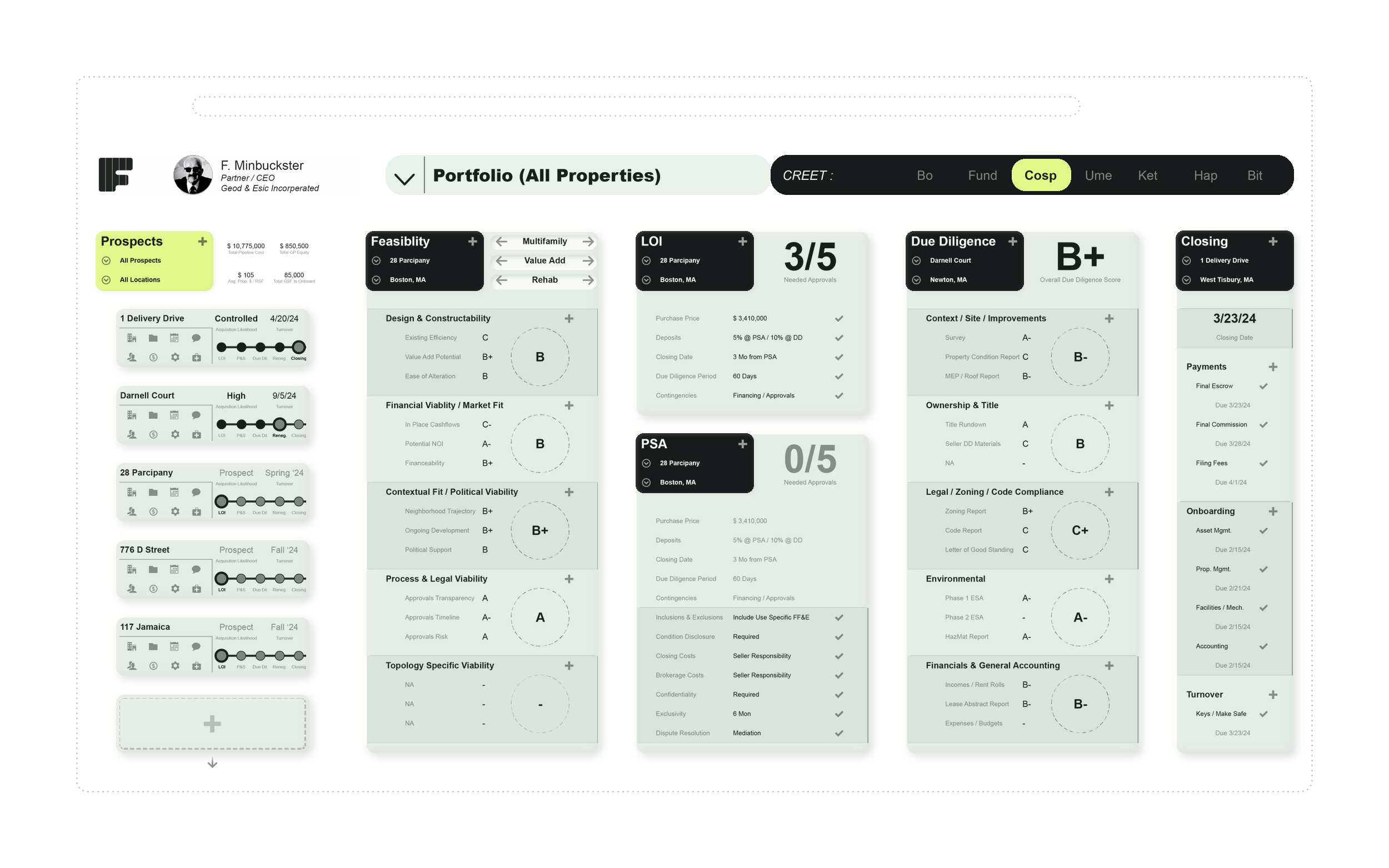
COSP is Fuller’s intended transaction pathway. FEAS addresses comparable project scenarios, and VALI addresses professional validation of a selected scenario. Ask any prospective platform to show how assumptions are shared while each decision retains its owner, conditions and version. A selected scenario should not overwrite the live property baseline or imply that financing, contracts or construction have been authorized.
Evaluate the difficult handoff, not just the pipeline
Use a sample opportunity with one changed assumption, one unresolved condition and an approaching decision date. Require the presenter to explain the current recommendation, the evidence behind it and the authority needed to advance. Test how the team records a hold or rejection as carefully as an approval.
Then follow a hypothetical closing into operations. Identify what the asset manager receives, which risks remain open and who owns outstanding obligations. A useful handoff retains the property identity and decision history without copying an entire data room into an unexplained folder. The Fuller designs illustrate the proposed interfaces; live transaction capability, supported data sources and any integrations must be confirmed before a pilot. Registering interest currently provides no MVP access.
Where this fits in Fuller
Fuller is presented here through its interface concepts and intended workflows. MVP access is currently locked. Registering interest does not create an account or provide access; availability, supported connections and a pilot scope must be confirmed before an evaluation.
Questions to ask before choosing software
How is a due diligence checklist different from a decision record?
A checklist shows requested items and task status. A decision record explains the recommendation, relied-on evidence, unresolved conditions, reviewer and authority. A dependable transaction process needs both.
Does a market-data connection prove an assumption is correct?
No. The date, comparability, methodology and selected interpretation still matter. A supplier should explain the supported source and refresh process, while the domain reviewer remains accountable for the adopted assumption.
Where do COSP, KET, HAP, FEAS and VALI fit?
COSP covers the intended transaction pathway; KET market evidence; HAP local intelligence; FEAS project alternatives; and VALI professional validation. They are related views with different decision owners.
What should transfer to the asset manager after closing?
The accepted property facts, decision rationale, controlling-document references and unresolved obligations should have named owners. The handoff should preserve the transaction history and make remaining uncertainty visible.
Tell us what you’re working on.
MVP access is currently locked. Register your interest and describe the work you want to connect.
Register interest in this workflow ↗