
Start with the decision, not the dashboard
Choose one recurring decision that currently takes too much reconstruction: a variance review, a capital intervention or an updated asset business plan. Identify the person who prepares it, the person who can approve action and the property team that must execute the result. Their responsibilities overlap, but their authority is different.
For a first evaluation, use one property and one reporting period. List the current record for areas, leases, operating results, approved projects and key obligations. Record what is confirmed, what is proposed and what remains unknown. A missing figure should remain visibly missing instead of becoming zero in a portfolio average. The aim is a usable, explainable decision, not the largest possible collection of charts.
Separate the asset record from scenarios and source systems
An asset manager needs continuity as a property moves through acquisition, improvement and operation. Give the property a consistent identity across those stages. Keep proposed changes separate from accepted facts, and preserve the date and source of each material update.
Accounting actuals, executed agreements and specialist operating records still need named owners. Ask a supplier to demonstrate how corrections, conflicting submissions and reporting periods are handled. A claimed integration is not enough: request the supported connection, fields, direction, refresh method and failure behavior. If a manual import is the practical starting point, document its reviewer and reconciliation step. Do not assume a product replaces the general ledger because it displays financial information.
Test the handoff from observation to improvement
Use a concrete scenario: operating costs have increased and a project is proposed as the response. Follow the evidence behind the variance, the person recommending action, the approval needed and the destination of the work. Routine operating tasks and material physical changes need different routes.
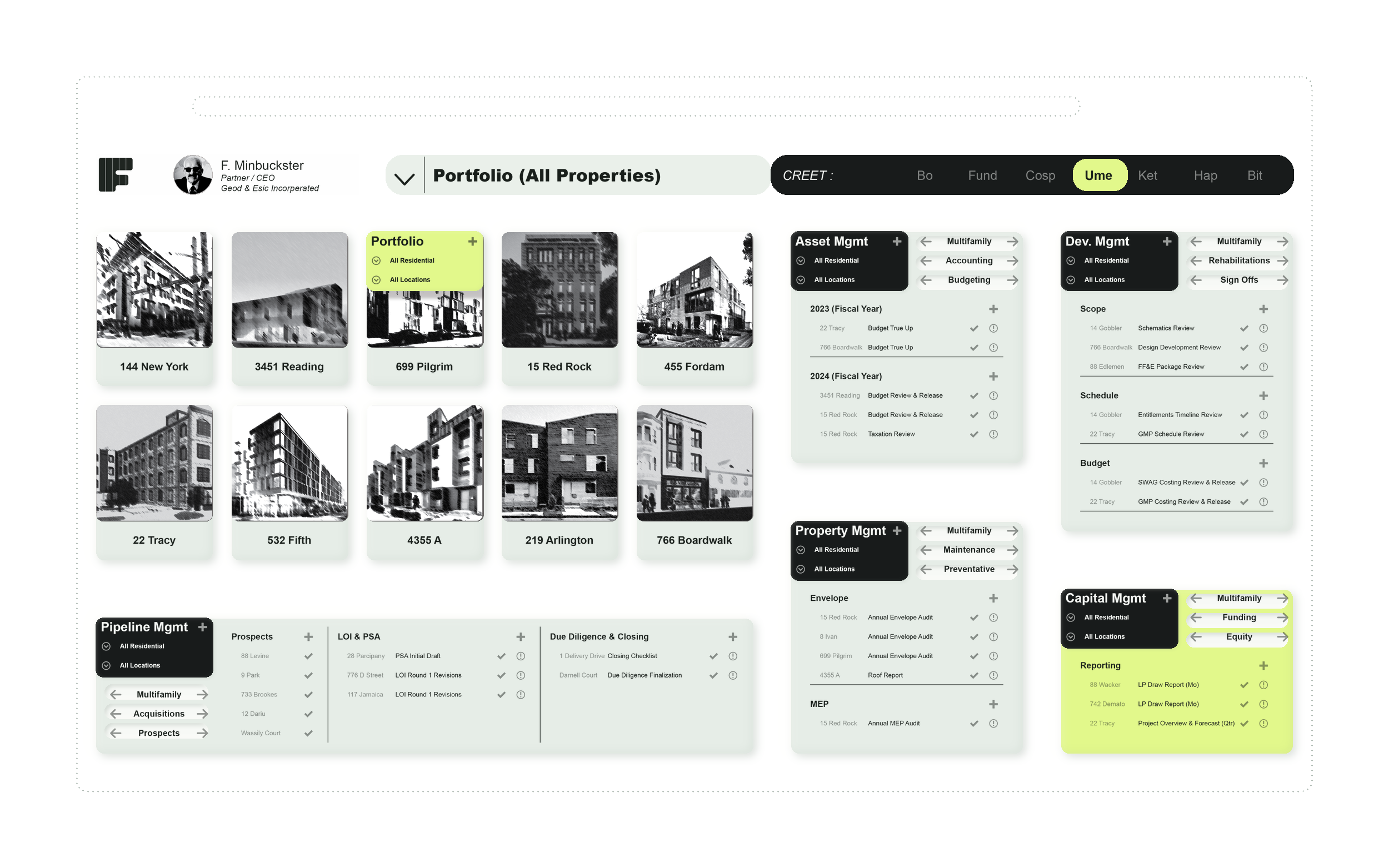
Fuller’s intended model gives UME the ongoing asset and portfolio view. GRO addresses diagnosis, proposed interventions and measurement of benefits; BO provides an executive review across teams. Framework addresses a physical project when the intervention warrants one. These distinctions are useful evaluation questions, not a statement that each step is currently available in the MVP. Browse the corresponding interface designs to see the proposed separation of responsibilities.
Run a small evaluation with measurable acceptance criteria
Ask the asset manager and property partner to prepare the same review with their existing process and the proposed workflow. Check whether they can explain the same values, identify an overdue decision and retrieve the evidence without privately rebuilding the story. Include one incomplete record and one corrected submission so the demonstration tests uncertainty as well as the happy path.
Before extending to more properties, agree who maintains the records, who approves baseline changes and how information can be exported. Record preparation time and correction effort as a baseline, then observe any change over a defined period. Do not treat a polished screen or a projected efficiency gain as proof of performance. A successful evaluation produces a decision people can trust and a workflow they can keep current.
Where this fits in Fuller
Fuller is presented here through its interface concepts and intended workflows. MVP access is currently locked. Registering interest does not create an account or provide access; availability, supported connections and a pilot scope must be confirmed before an evaluation.
Questions to ask before choosing software
How is asset management different from property management?
Asset management connects a property’s business plan, performance and investment decisions. Property management coordinates its daily operations. The teams need shared context, but accounting, approvals and specialist responsibilities should stay explicit.
Should portfolio software replace our accounting system?
That depends on the verified scope of the selected product. Start by naming the system that owns accounting actuals, then test reconciliation and supported data exchange. A dashboard alone does not establish accounting capability.
Which Fuller interfaces relate to this workflow?
UME is the intended asset and portfolio interface; GRO addresses operating improvement and measured benefits; BO addresses executive oversight. Their designs are available to explore, while MVP access remains locked.
What should a first pilot include?
One property, one reporting period, one recurring decision and named reviewers are enough to expose record ownership and handoff problems. Agree on actual product availability and data handling before sharing working records.
Tell us what you’re working on.
MVP access is currently locked. Register your interest and describe the work you want to connect.
Register interest in this workflow ↗