
Organize the meeting around decisions and exceptions
Start with the commitments that could affect the business plan: a funding condition, a delayed launch, a transaction deadline or a material asset variance. Separate matters requiring executive choice from work a department already has authority to complete. Give each exception a consequence, owner, due date and clear request.
The COO usually coordinates execution across teams, while the CEO or managing principal may decide strategic tradeoffs. In a smaller organization the same person may hold both roles. Write down the responsibility anyway. A compact decision list is more useful than a status deck that requires everyone to explain their own interpretation of green, amber and red.
Require a source, period and completeness for every measure
Two departments can report different answers because they use different periods, populations or definitions. Before combining their measures, identify the source record, selected properties or projects, reporting date and known omissions. A missing submission should be visible in the executive view rather than disguised by an apparently healthy aggregate.
Ask a software supplier to demonstrate a summary, its underlying records and one corrected submission. Check whether the change is explainable after the meeting. Leadership needs enough context to act, but executive visibility should not automatically grant unrestricted access to privileged legal material, employee information or every investor record.
Keep the executive layer connected to domain ownership
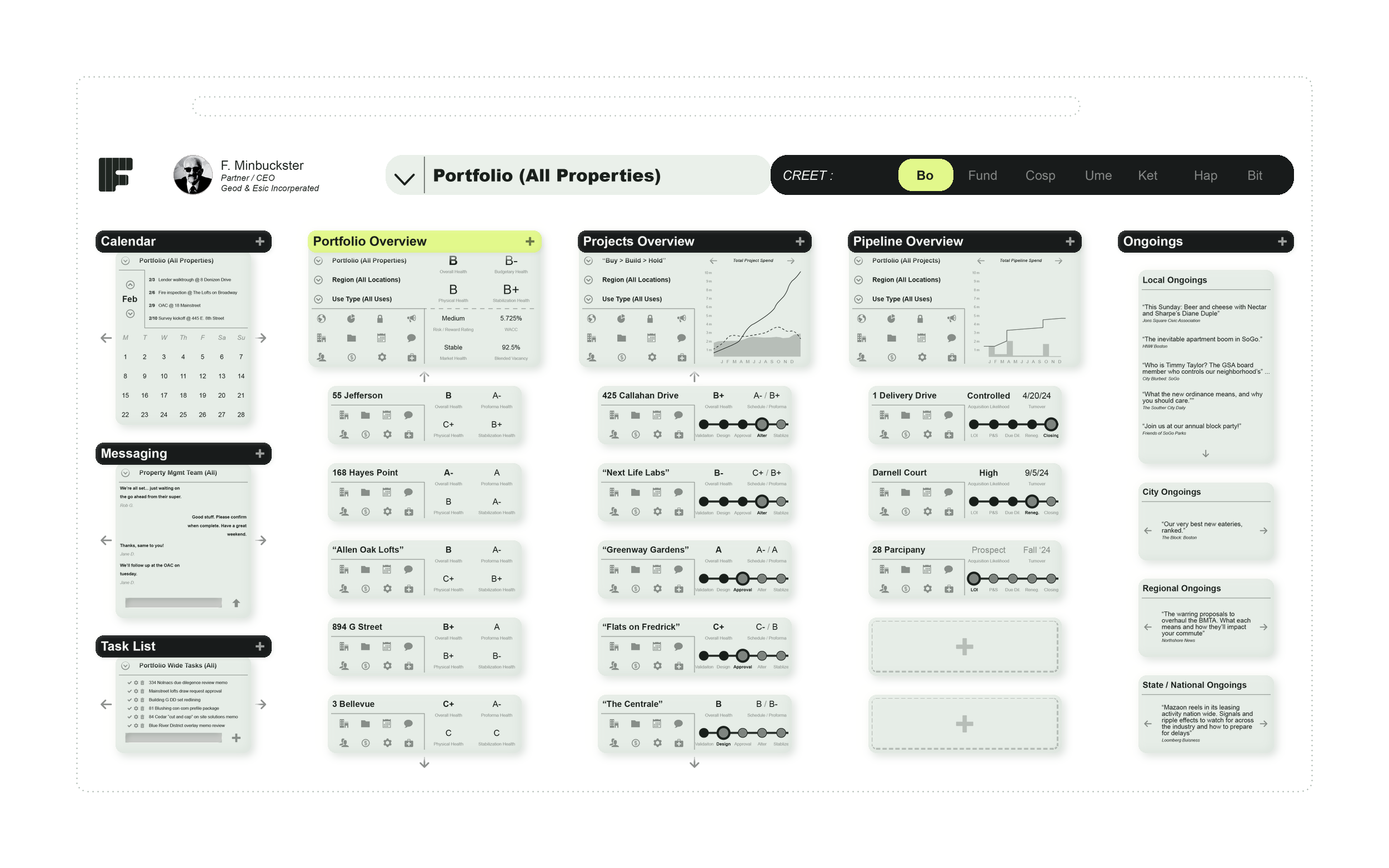
Fuller’s intended BO model brings property activity, portfolio, project, pipeline and local context into an executive operating surface. UME, FUND, COSP and Framework describe the underlying asset, capital, transaction and project responsibilities. BIT supplies the related organizational processes, controlling records and procedures.
Use those boundaries to ask where decisions are actually executed. Acknowledging an executive alert should not close an unresolved project issue. Approving a business priority should not silently create financing authority or rewrite a contract. A new procedure should not retroactively alter old decisions. Each department must retain the records and approvals it is responsible for maintaining.
Test a review that crosses more than one department
Choose a representative scenario such as a project delay affecting occupancy timing and capital needs. Have the development, asset management and finance participants prepare their evidence, then ask leadership to make an explicit decision. Record the rationale, authorized action and follow-up owner. Revisit it at the next review to see whether the underlying work actually advanced.
Before scaling the process, agree on one definition of completion and a manageable review cadence. Measure preparation effort, unresolved decisions and correction needs against a starting point; do not mistake notification counts for effective execution. Fuller’s interface concepts can support the discussion, but MVP access remains locked. Any pilot should confirm available workflows, permissions, source connections and exit arrangements before relying on it for executive decisions.
Where this fits in Fuller
Fuller is presented here through its interface concepts and intended workflows. MVP access is currently locked. Registering interest does not create an account or provide access; availability, supported connections and a pilot scope must be confirmed before an evaluation.
Questions to ask before choosing software
What should a real estate COO dashboard show?
It should make business-critical exceptions and decisions understandable: consequence, evidence, responsible owner, deadline and required authority. The exact measures depend on the organization and should reconcile to the underlying teams’ records.
Is BO intended to replace the asset and project interfaces?
No. In the intended Fuller model, BO provides executive context while domain interfaces retain their responsibilities. It should help leadership understand and coordinate decisions, not create a second version of every source record.
How does BIT differ from BO?
BO addresses executive operating visibility and exceptions. BIT addresses organizational processes, accounting and legal coordination, controlled documents and procedures. Actual supported behavior remains subject to product verification.
How do we know if an operating review is improving?
Set an initial baseline for preparation effort, unresolved decisions and follow-through. Observe the same measures over a defined period and retain the underlying evidence instead of assuming a dashboard produced the improvement.
Tell us what you’re working on.
MVP access is currently locked. Register your interest and describe the work you want to connect.
Register interest in this workflow ↗