
Mini packet · PROP-1042-SEAPORT · FY26 Q2 close
Close / ops packet — PROP-1042-SEAPORT
Readable document for deep-page arrival from the ORG-01 seam. Same property ID. Three SAMPLE capital states. CFO checklist below — print-friendly, not a banner-only teaser.
CFO close checklist (sample · 5 lines)
- Confirm property ID on close packet matches ongoing asset record:
PROP-1042-SEAPORT(no second record). - Reconcile capital states: modeled $48.2M → committed $41.0M → funded $36.5M.
- Ledger (Yardi / MRI / equivalent) remains system of record; Fuller reconciles — does not replace the books.
- Named handoff owner Jordan Hale (Asset Manager) signs asset activation on the same ID.
- Attach closing evidence to the canonical property; deal history must survive into operations.
Buyer and triggering problem
Buyer: asset manager, partnered with the portfolio manager — the people who must explain what a property is, how it performs, and what should change.
Trigger: operating reports, leases, project changes, and financial assumptions describe conflicting versions of the same property. Reporting time becomes reconstruction time. A new manager cannot find the controlling plan.
From the atlas: start with one reliable property record when acquisitions, projects, leasing, and operations generate incompatible versions of the same asset. Organization archetypes that feel this first: integrated owner/operator (ORG-01), investment manager/fund sponsor (ORG-02), and third-party property & asset management firms (ORG-06).
Bounded workflow
UME is the ongoing asset record — the canonical property operating context. Plain language first; the desk code comes after the job is clear.
Inputs
- Physical hierarchy, spaces, equipment, condition
- Financial lines, assumptions, accounting actuals, forecasts
- Occupancy, agreements, work requests, obligations
- COSP transaction history and FUND capital references
- Framework proposed changes and ABIL application packages
Decisions
- Prioritize operating actions and recommend strategy
- Approve property-level work within delegated limits
- Keep baseline vs proposed scenarios distinguishable
- Request corrective action when evidence conflicts
Roles
- Asset manager owns business-plan outcome
- Portfolio manager allocates attention across assets
- Property / facilities / leasing specialists maintain domain evidence
- Controller retains accounting actuals in BIT or the named ledger
Outputs
- Current property baseline and portfolio rollups
- Asset business plan and prioritized management work
- Owner reports with variance explanations
- Project opportunities or authorized asset-application decisions
Annotated evidence
Use this overview to evaluate whether a decision can travel from a portfolio summary to the underlying property evidence — not as decoration.
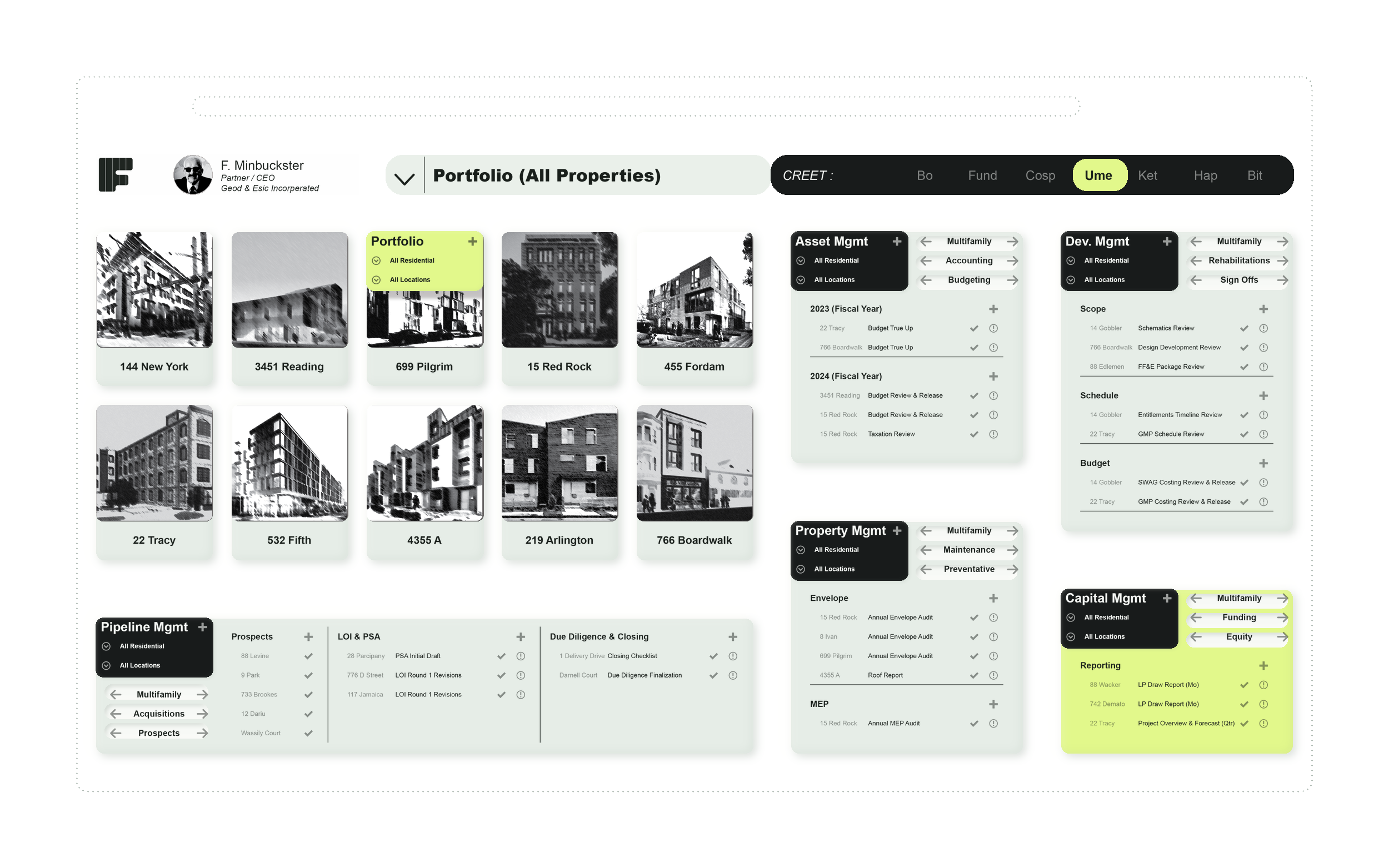
Browse UME desk on the front door ↗ · PROP-1042 capital states ↗
Handoffs and what stays authoritative
- COSP → UME: closing activates ownership on the existing property identity — do not create a second asset record.
- UME → FEAS: transfer baseline, purpose, constraints, and business-plan assumptions into a project scenario.
- ABIL → UME: only reconciled, authorized project deltas enter the live baseline through Asset Application; prior baseline is preserved.
- OCU ↔ UME: share the maintenance request and access fields; keep private occupant routines private.
- FUND / BIT: reference capital and accounting sources; do not invent a competing ledger.
Objections that decide the purchase
Will this preserve our accounting calculations?
It must. Name the system that owns accounting actuals, then test reconciliation and supported import paths. UME is not a silent ledger replacement.
Do property managers get a daily workflow, or only an investor dashboard?
Evaluation criterion: site teams need practical queues for requests, vendors, and local obligations — not only portfolio charts.
Can we keep prospect, baseline, project adjustment, and combined views distinct?
Yes — that separation is part of the intended model. A project forecast must never silently overwrite the live asset baseline.
What about permissions for external managers?
Third-party managers work within client mandates and separate scopes. Owner approval remains required for reserved investments and baseline application.
Availability honesty
CONCEPT INTEREST LIST NOT GA
This page describes intended workflows and interface concepts. Fuller MVP is locked. Joining the founding list does not create an account, grant access, or imply a verified integration list. Capabilities shown are illustrative unless separately confirmed for a scoped evaluation.
Join the founding MVP interest list.
This is not an account and not general availability. Tell us the workflow you need to evaluate. Founding framing includes badge + illustrative founding rates shown beside list rates at the studio door.
Join founding list ↗ Email Arthur